
DUCKS FROM G.O.D.
Words by Greg Clarke (Originally published in Scrag End Journal)
On the southwest coast of Victoria, nearby the well-visited Twelve Apostles and Great Ocean Road, farmland made rich by regular rain is often a luscious green, yet daubed with black and white. This is renowned dairy country and Friesian cattle are almost as common as the swells that pound the coastal cliffs. But on a hill, on a small 16ha farm overlooking the Southern Ocean, in a chink of the Great Ocean Road and the small town of Port Campbell, there are our Aylesbury and Pekin ducks.
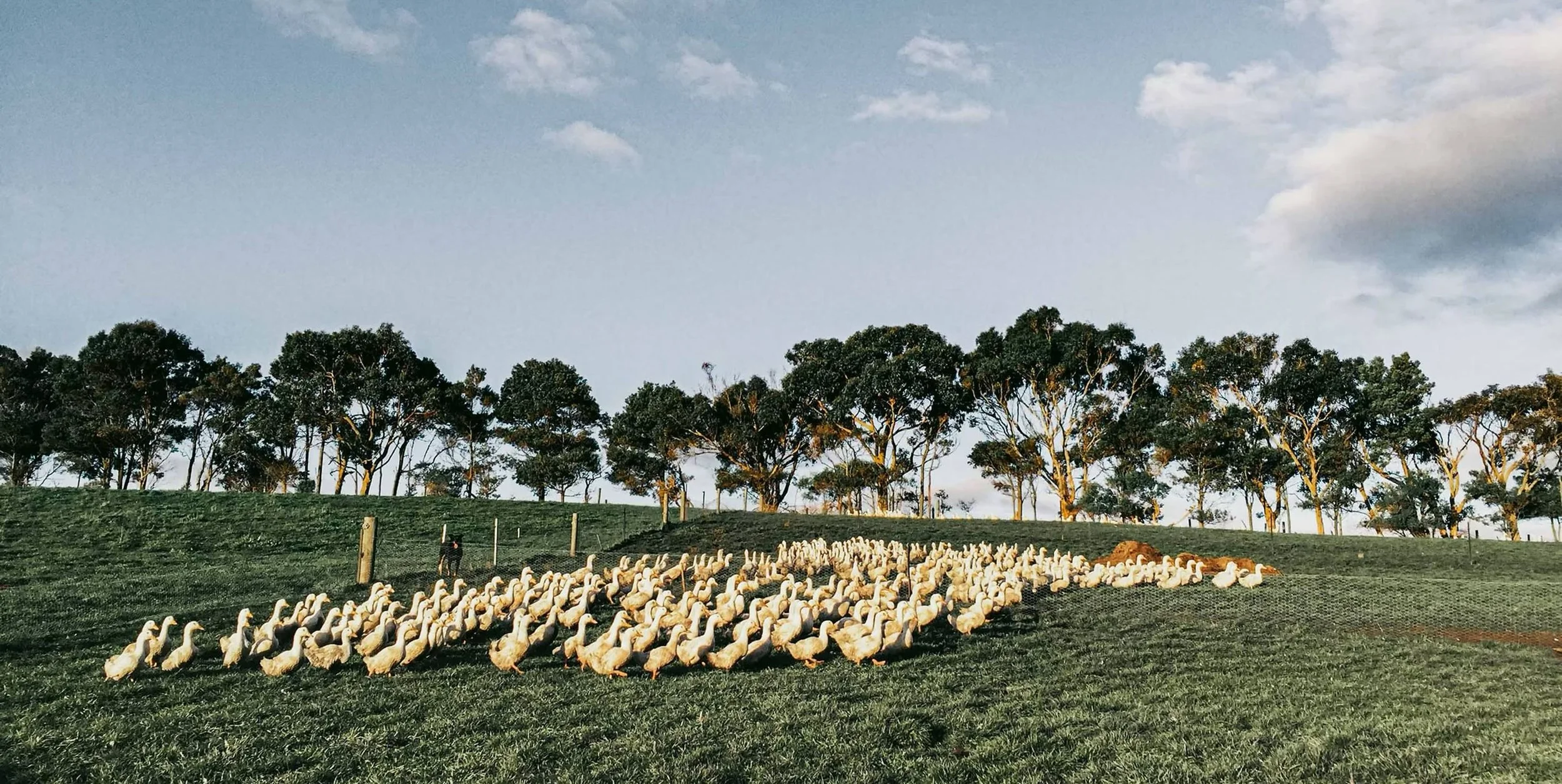
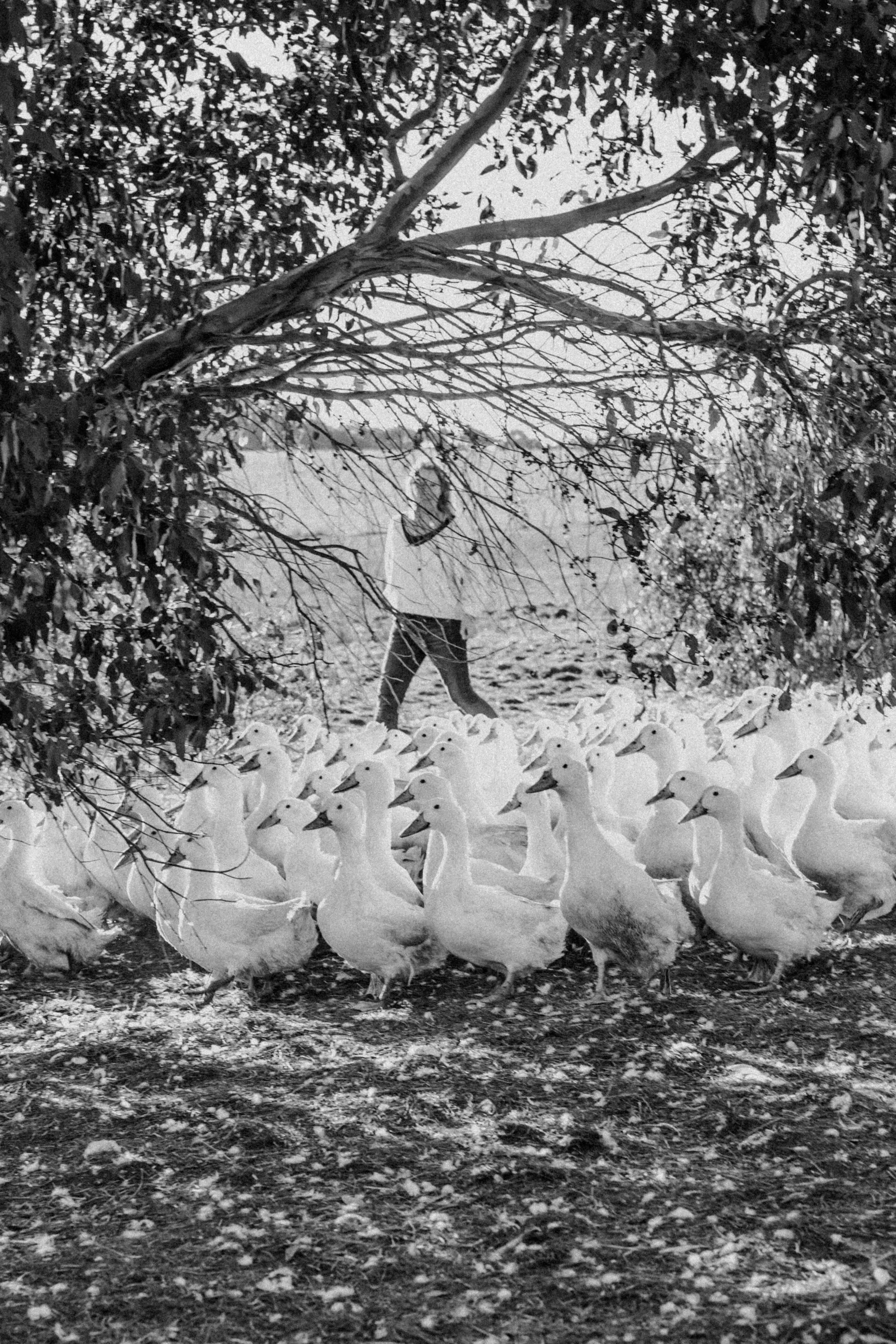
— The flock on the farm nearby Port Campbell, VIC
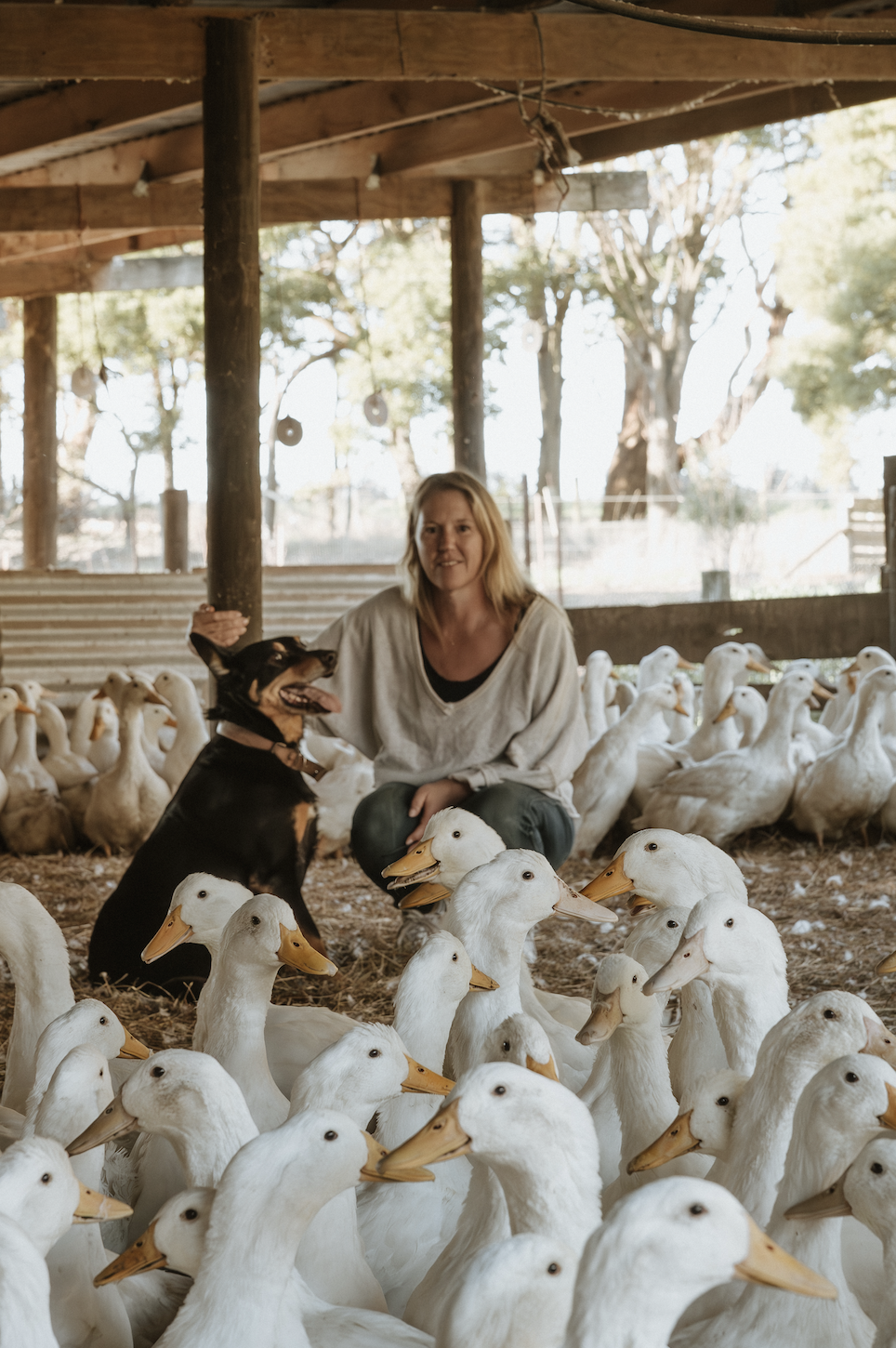
My wife, Jodi, and I today have some 900 birds and sell weekly batches of them to a clutch of restaurants in Melbourne and country Victoria. We hatch and rear the Aylesbury, muster them to and from their sheds and paddocks, and eventually deliver them. First to the abattoir and then to the restaurants. Crucially, we are responsible for the entire process, and this includes the prices we charge.
Originally Jodi and I were two city-types, but we have lived on our farm now for ten years. For the first years we experimented with cows and calves, turning off a dozen vealers in a good year. Inevitably we sold them through the auction system to buyers at the local sale yards, an unhealthy experience. Sometimes these vealers fetched hundreds of dollars per head less than I thought that they might. These buyers left a taste in my mouth that could only be worse if I’d licked the floor of my stock agent’s truck. We didn’t know it at the time but we were being taught a vital lesson.
It was four years ago that we came to a point where we felt we needed to do justice to our rich land. We wanted to make it work, we wanted it to be far more productive and there was only one caveat — it couldn’t be fashionable, we didn’t want to buy into a fad.
Jodi was working as a mum, meanwhile I had a full-time writing gig, and yet both of us were drawn into what we see as a broad revolution — a good food movement where animal welfare is, at least for as long as they are alive, as important as how the animal tastes after its transformation to food.
“It was four years ago that we came to a point where we felt we needed to do justice to our rich land. We wanted to make it work, we wanted it to be far more productive and there was only one caveat — it couldn’t be fashionable, we didn’t want to buy into a fad.”
After tossing up a million ideas, Jodi came up with the suggestion to farm ducks — from where I have no idea as it was a radical leap from thoughts involving saffron, wasabi and the calf rearing that we had originally tossed about.
After a little research we decided on the Aylesbury breed. We were lured in by the historical connection as a wildly popular table duck back in 19th century England and as a bonus it also came with a rare-breed status. We bought our first 30 infant Aylesbury ducks in 2009 and transported them home in cardboard boxes in the back of the family car. We were flying blind, until we picked up our ducks we had no experience with them but we were to learn our first lesson quickly. In the car on the four-hour trip home, we found out that ducks are gold-medal shitters. The smells from the boxes skewered our nostrils.
We built our first shed, somehow managed to keep the ducks alive and we slowly grew (almost) used to their smell. We watched them grow, amazed that we didn’t inadvertently kill even one. And later, when it came to meal trials on some drakes, I couldn’t deliberately kill even a single one. I had made the mistake of growing attached.
Calling a local friend to dispatch and help pluck, they were shared with friends, and the feedback was enormously positive.
As the females matured we collected eggs, incubated them, and after many disasters, began hatching ducklings in our home. In hindsight, each of our heartbreaking tribulations should have been expected. Once, we set 50 eggs in an incubator and managed to hatch only one duckling, simply to have it die a few days after. Almost everything we have learnt has been by trial and error.
Both Jodi and I grew up in Melbourne, we moved to Port Campbell from London. My wife worked in real estate in once-groovy Notting Hill and came to Port Campbell having never used a shovel. By starting a business that we knew nothing of, we were breaking that golden rule but I wouldn’t say we were entirely clueless. Through my work as a writer I’d met and written frequently about chefs and small-scale farmers and already had some, if only the tiniest amount of insight. I knew that there were some chefs, those who sourced produce from animals that for as long as they are treading earth, are able to contentedly swish their tails, stretch their wings, and maybe even get the odd scratch and talking to from an equally contented farmer.
“Jodi would spend hours plucking in a cool room only stopping when she could pluck no more. ”
I also knew that some niche farmers nurture produce of such quality they have cultivated their own renown. Something which is deservedly brilliant and it is these guys and girls who have bombed the trail Jodi and I are following — people who work almost the exact opposite way to the factory farms.
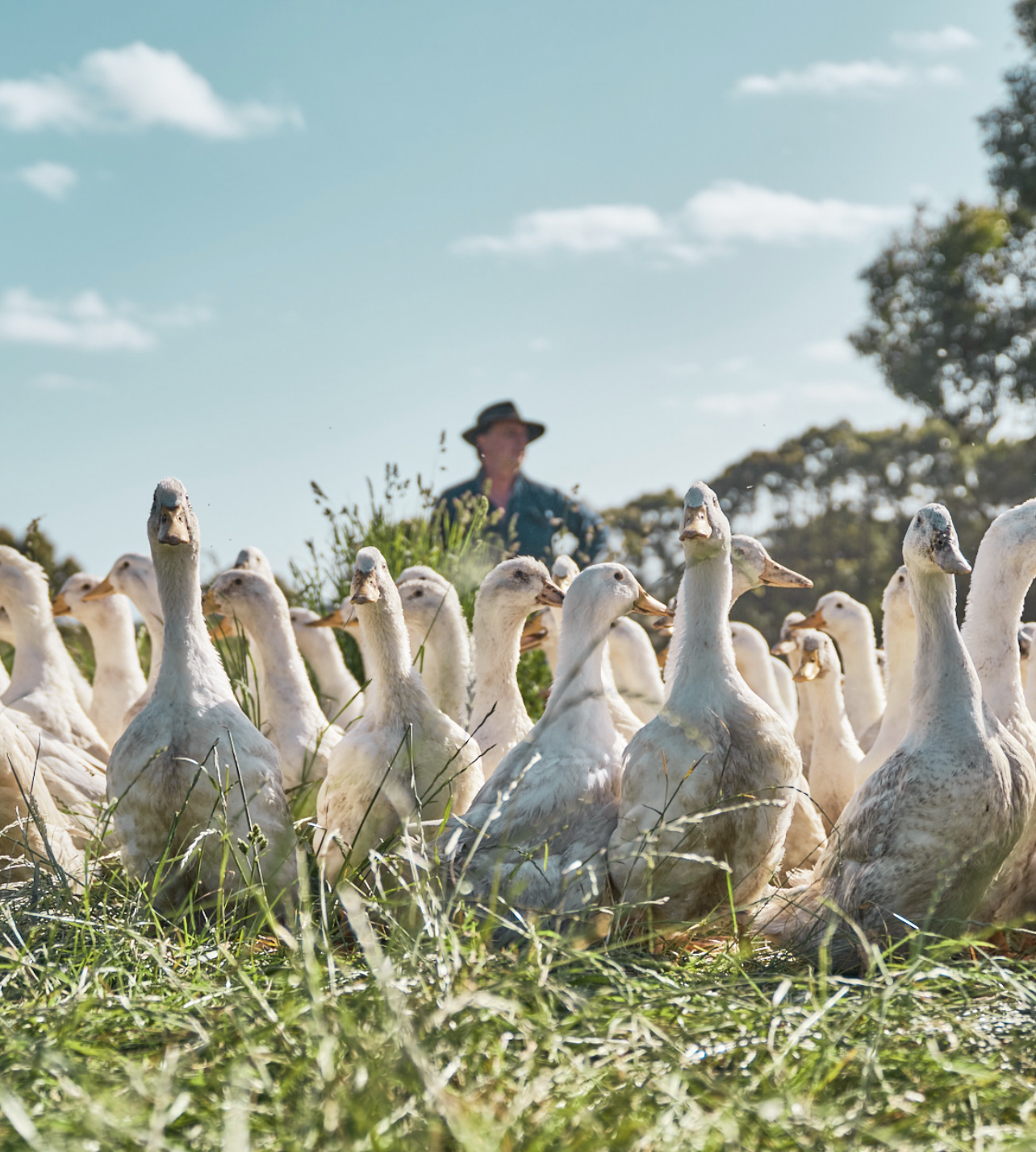
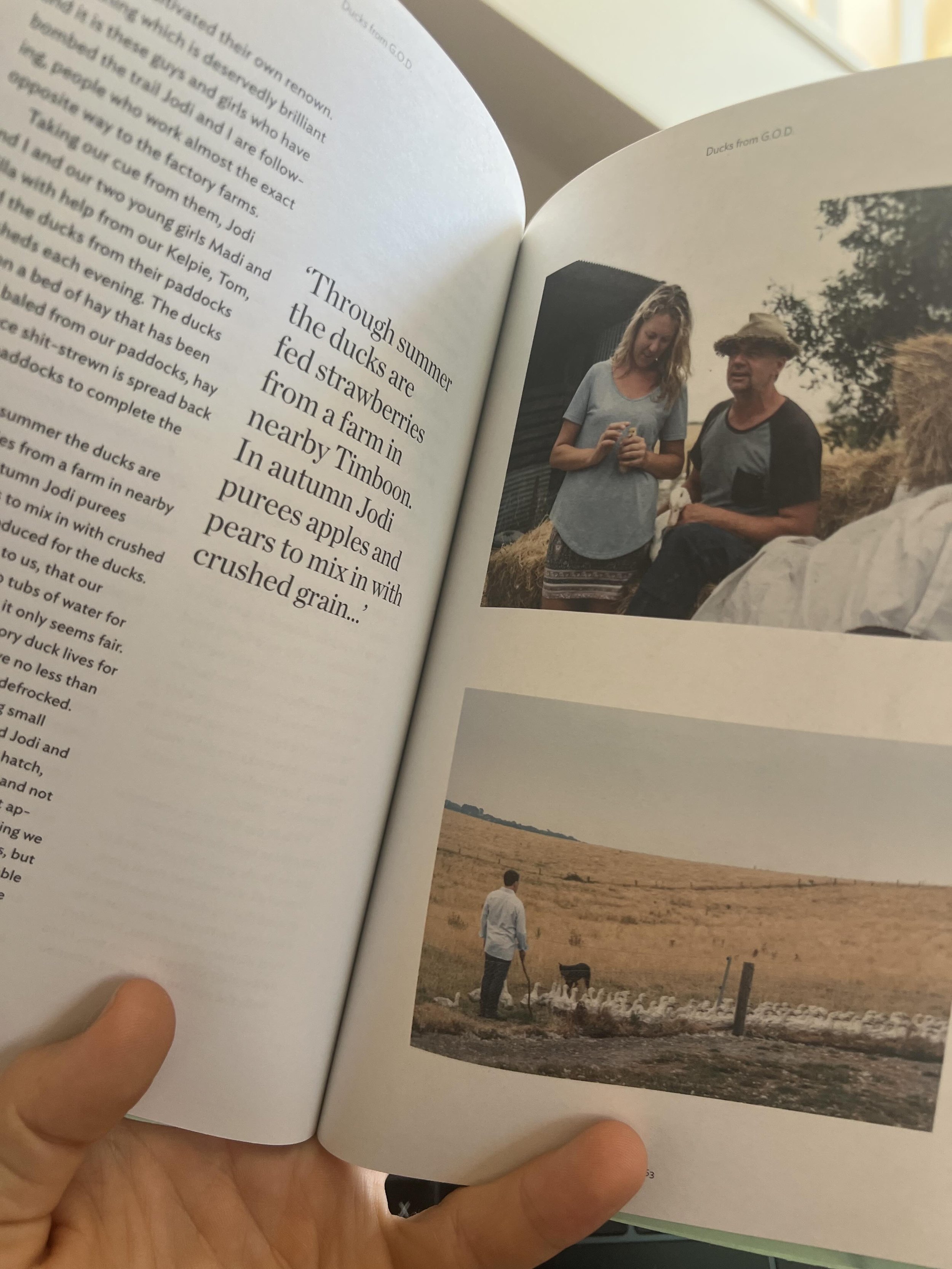
Taking our cue from them, Jodi and I and our two young girls Madi and Milla, with help from our Kelpie, Tom, herd the ducks from their paddocks into sheds each evening. The ducks sleep on a bed of hay that has been cut and baled from our paddocks, hay which once shit-strewn is spread back onto the paddocks to complete the cycle.
Through summer the ducks are fed strawberries from a farm in nearby Timboon. In autumn Jodi purees apples and pears to mix in with crushed grain specially produced for the ducks. It is also important to us that our ducks have access to tubs of water for preening and playing, it only seems fair. While the average factory duck lives for 6–8 weeks, our ducks live no less than 12 weeks before they are defrocked.
Our experiences selling small numbers of cattle convinced Jodi and I that if our duck plan was to hatch, we needed to be price setters and not price takers. We worked hard at applying a cost to each duck, knowing we couldn’t attribute our labour costs, but we had to make the venture enjoyable and viable — we needed a reasonable return on our committed funds.
There are some circumstances where we might consider doing this job only for love, if we could live on thistle soup, weren’t confronted by ever-rising rates, insurances and fuel costs and Jodi’s urge for shopping had maybe subsided — the reality is though that everybody needs to eat.
So we are taking a stand, it is ultimately the quality of our ducks that will determine what the market will pay. The day our produce is only comparable to what comes from the factory, our business is as worthless as our often maxed-out credit cards. The fact is our ducks cost more to produce than the retail price of the factory birds, we can’t and won’t ever begin to compete on price. The one certainty though, is there is little point running a farm, regardless of the lifestyle which allows us the pleasure of being home with our girls before and after they go to school, if we can’t eventually turn a profit. We sell every duck we produce but the profit thing is yet to come.
During our efforts to become farmers we’ve had phone calls from wonderfully friendly people, they say they have heard great things about our ducks. Inevitably they offer to buy every bird we produce and benevolently suggest their company even do our marketing and our invoicing. Then each time it comes for these wholesalers to preach dollars and they suggest a figure less than our cost to produce.
Is this an inkling of how dairy farmers or fruit growers who are far more financially committed than we are feel when they are offered ruinous prices for their vats of milk or orchards of juicy fruit? Perhaps I shouldn’t be surprised by the calls, yet I always am. Once one came from some people behind a renowned Melbourne dining institution. They tried our ducks, loved them, but asked if they ordered big numbers, could we supply them at the same price as the factory birds. Oh to have the plumbs to name and shame.
For the first three years of our ducking exploits, Jodi ran the business. Hellishly, this involved plucking ducks at an abattoir in Geelong as the workers themselves didn’t care much about presentation. This was short-lived thankfully as we eventually found an abattoir not too far west of Melbourne that transforms our ducks from alive to food with such expertise that Jodi’s fingers are no longer required.
During these early days, we sold every duck we produced, around 50 a fortnight, to Andrew McConnell’s well-known restaurants Cutler & Co. and Cumulus Inc. Jodi would spend hours plucking in a cool room only stopping when she could pluck no more. Her tortured fingers and mind soothed by the fact that our infant farm business was a way for her to be at home with the girls. All the while during this time I mostly contributed by writing a monthly column, one that often humorously looked at our attempts to become farmers.
I once wrote about Jodi and her fetching blue lips as she plucked ducks in the abattoir’s chilled environment — but not without consequence. Farming, as with all small business, tests marriages. Yet by the time I was made redundant in 2012, Jodi and I were fortunately again talking as our home and farm are rather small. One morning over coffee, we discussed expanding into Pekin ducks as a way of further commercialising our efforts. We just couldn’t see any time soon when we would hatch enough Aylesbury in our fast-ageing incubators to satisfy either our customers or the bank.
In 2013, from an agreeable duck farmer we had fortuitously met, we began to buy infant Pekins. This move required some dramatic and costly expansion early on, in turn forcing the consequential decision to put a significant price rise on our ducks. It was a decision equally driven by commercial realities to make a success of the farm as it was to be able to keep living and caring for our kids in the home that we had built.
Tasked with notifying our customers, Jodi began to email and text. She made phone calls advising the chefs who buy our ducks of the increase and we nervously waited for orders to be cancelled. We were asking ourselves if we had priced ourselves out of the market?
Our business is called Great Ocean Ducks, some chefs, at least those with a sense of humour, joke with us about putting GOD on the menu, while a gaggle of chefs address emails with GOD in the subject heading. While people might find this offensive, it is not in my nature to cause offence. In fact I have wondered whether I should even describe myself as a genuine farmer in fear that I’d upset rural relatives, those who for decades before us, have been turning water and dirt into food.
“Our business is called Great Ocean Ducks, some chefs, at least those with a sense of humour, joke with us about putting GOD on the menu, while a gaggle of chefs address emails with GOD in the subject heading.”
Yet while every day Jodi and I learn more about this business, we’ve acquired enough information to know that the play on GOD is nowhere near as offensive as those who see fit to offer farmers such hellishly ruinous prices for their produce. We are still a long way from commercial viability, as there are many external forces. The thoughts of disease and officious regulators threatening to kibosh our efforts can cause us to shake involuntarily. As it stands though, since the price rise, we haven’t yet opened an email from a chef that has cancelled their order from G.O.D.
Images supplied by Great Ocean Ducks
Scrag End Journal originally published by Björn & Sascha Rust in 2016
Key Stats
Founded: ~2009–2010, Port Campbell, Victoria (Great Ocean Road region)
Scale: ~900 ducks in rotation; small-batch, weekly supply to Melbourne and regional Victorian restaurants
Breeds: Aylesbury (heritage) and Pekin ducks
Practices: Pasture-raised; ≥12-week grow-out (vs 6–8 weeks industrial); on-farm hatching and rearing; open water access; straw bedding returned to paddocks; seasonal whole-food feeding
Business Model: Free-range managed (grow → process → deliver); direct-to-chef; price-setter, not wholesaler-led
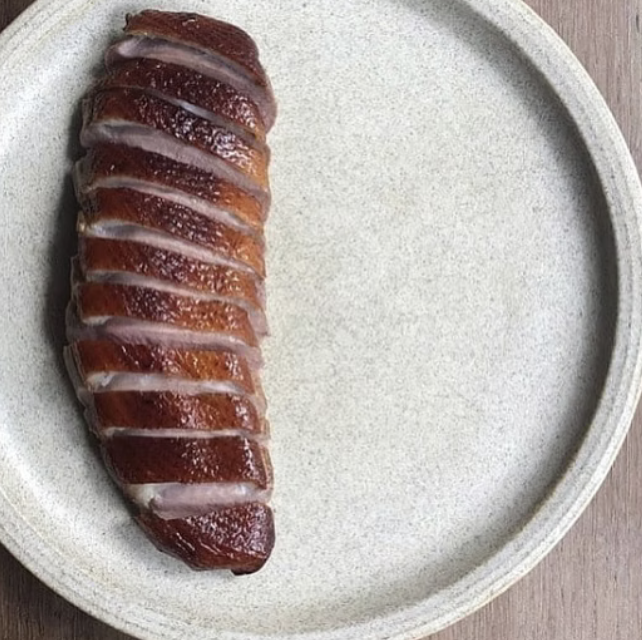
Product: Whole ducks for premium restaurants under the Great Ocean Ducks name